
What to choose if you are a Slovak or Czech company? For banks and insurance companies with legacy systems, manufacturing companies connected to SAP, retail chains with Power BI reporting, and growing technology companies - the answer is different for all of these players. And for most of them, it is much simpler than it might seem.
What each platform actually means
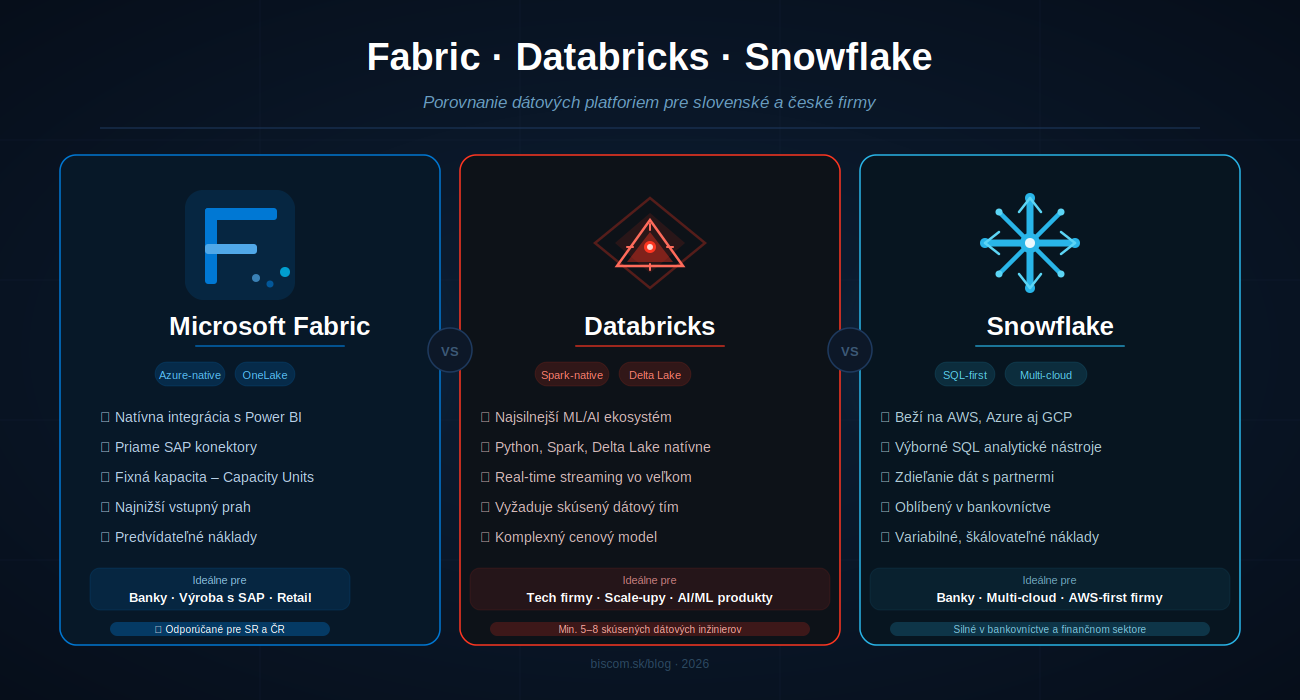
- Microsoft Fabric is Microsoft's attempt to create a "Windows for data" - a single place for engineering, analytics, reporting and AI. Built on Azure, tightly integrated with Power BI, Teams, Microsoft 365 and SAP connectors. Launching in 2023, it is developing rapidly.
- Databricks is a platform for bold engineers. It was created as a commercial extension of Apache Spark, today it is a full-fledged lakehouse environment for teams that build ML models, process huge volumes of data, and want maximum flexibility. It requires a technically proficient team.
- Snowflake is a classic cloud data warehouse – but done exceptionally well. It separates storage from compute, scales seamlessly, has an excellent SQL interface, and is available on AWS, Azure, and Google Cloud simultaneously.
Five questions that will decide for you
1. What is your existing technology stack?
- If you have a Microsoft ecosystem (Azure, Power BI, Microsoft 365, Teams, SAP with Azure connector): Fabric is a natural choice. Integration is native, data does not need to be duplicated, Power BI draws directly from OneLake without imports. For a company that already pays for Microsoft 365 and Azure, Fabric is the most attractive price.
- If you are multi-cloud or AWS-first: Snowflake runs equally well on AWS, Azure, and Google Cloud. Databricks does too. Fabric is Azure-only – which is either an advantage or a limitation, depending on your situation.
- If you have SAP: In the CEE region, SAP is dominant. Fabric has direct SAP connectors and benefits from a long-standing Microsoft-SAP partnership. Both Snowflake and Databricks have them through partners.
2. How many data engineers do you have and what level are they?
- Databricks requires a truly technical team. Spark, Python, Delta Lake, cluster management, DBU optimization – these are skills that are hard to find and expensive to pay in Slovakia and the Czech Republic. If you don't have at least 5–8 experienced data engineers, Databricks will hurt you.
- Snowflake is SQL-first. If your team is good at SQL and familiar with data modeling, Snowflake will get you up and running relatively quickly. Administration is easy, the infrastructure is fully managed.
- Fabric has the lowest entry threshold for companies with existing Microsoft know-how. Power BI, Azure Data Factory, SQL endpoints – all accessible without Spark expertise.
3. What is your primary use case?
| Use case | The best solution | Alternative |
| BI reporting and dashboards (Power BI) | Fabric | |
| SQL analytics, governed DWH | Snowflake / Fabric | |
| ML models, AI, big data engineering | Databricks | |
| Structured data from ERP/SAP | Fabric | Snowflake |
| Real-time streaming on a large scale | Databricks | |
| Self-service analytics for business users | Fabric | |
| Multi-cloud data sharing with partners | Snowflake | Databricks |
For most Slovak and Czech companies (BI, governed DWH, SAP integration), Fabric or Snowflake is a more natural fit than Databricks.
4. How predictable do you need your budget to be?
| Fabric | Snowflake | Databricks | |
| Model | Capacity (F2–F8192) | Pay-per-use (credits) | DBU + cloud infrastructure |
| Price (example) | from approx. 260 EUR/month (F2) | approx. 1.80 – 3.70 EUR/credit | variable, complex |
| Predictability | High (fixed capacity) | Medium | Low without optimization |
| Risk of surprise | Throttling when overflowing | Unforeseen invoice | Risk of unexpectedly high bill without tuning |
For financially conservative companies (banks, public sector, family businesses), the predictability of the Fabric Capacity model is often a decisive argument.
5. What is the availability of talent in the market?
| Fabric | Snowflake | Databricks | |
| Talent availability (SR/CR) | High | Medium | Low |
| Average onboarding time | 2–4 weeks | 4–8 weeks | 2–6 months |
| Necessary expertise | Azure, SQL, Power BI | SQL, data modeling | Spark, Python, ML |
| Suitable for a smaller team | Yes | Yes | Only for 5+ seniors |
In Slovakia and the Czech Republic, there is a clear hierarchy: Microsoft/Azure specialists are the most numerous on the market. Snowflake experts are increasing mainly in the banking sector. Databricks experts are rare and expensive - you are competing with large companies that attract them to international projects.
Recommendation based on company profile
| Company profile | Recommended platform | Reason |
| Bank / Insurance Company (Azure, SAP, Power BI) | Fabric or Snowflake | Regulatory governance, Microsoft ecosystem |
| Manufacturing company with SAP (200–2,000 employees) | Fabric | SAP connector, Power BI, predictable costs |
| Retail / FMCG company | Fabric or Snowflake | SQL analytics, Power BI reporting |
| Tech company / scale-up with ML/AI | Databricks | Flexibility, Python/Spark, AI/ML workloads |
| Multi-cloud or AWS-first company | Snowflake | Runs on AWS/Azure/GCP, sharing data with partners |
What do global benchmarks say?
From independent tests on 3 billion rows (2025):
- SQL query performance: Snowflake and Databricks are comparable on large workloads, Fabric is slightly slower on extreme loads - you won't notice the difference for typical analytical queries.
- Cost for the same workload: With a well-configured Fabric, the price can be 30–50 % lower than Snowflake Enterprise with similar performance - depending on the workload.
- Onboarding time: Fabric < Snowflake < Databricks (from simplest to most complex).
Important trend: platforms are converging
In 2025 and 2026, Microsoft and Snowflake signed interoperability agreements - data can be mirrored between OneLake and Snowflake without copying. Databricks and Fabric share the Delta Lake format.
This means that vendor lock-in is less today than it was three years ago. If you choose Fabric today and find out in two years that you need Snowflake for a specific use case, the migration won't be a disaster.
Conclusion: for most companies the answer is clear
If you are a company with 200–5,000 employees, operating on Azure or Microsoft ecosystem, and want to consolidate your data platform without hiring Spark experts – Microsoft Fabric is probably the right choice for you for 2026.
If you need multi-cloud portability or have a large SQL-first data team – Snowflake.
If you are building an AI/ML product and have a technical team – Databricks.